Open almost any corporate sustainability framework today and you'll find some version of the same instruction: design for disassembly.
Make the product easy to take apart. Separate the materials. Send each one into its own recycling stream. It sounds sensible, and sometimes it is.
But after years spent around wood in a small plywood factory in Hokkaido, Japan, I've started to wonder whether we think too much about how a product should end before we think enough about how it should live.
Wood makes this question hard to ignore. A thin sheet can curl when humidity changes. A piece that looks perfectly flat can behave differently as conditions change. Grain direction matters, species matters, even the weather outside the factory can affect what happens inside it. We deal with these small movements every day, so when we develop a wood-based material, the first question isn't usually how easily it can be taken apart later. It's how to make it stay where we put it.
One approach we use is to laminate thin veneers of domestic hardwoods — Japanese birch and basswood — with layers of recycled colored paper.
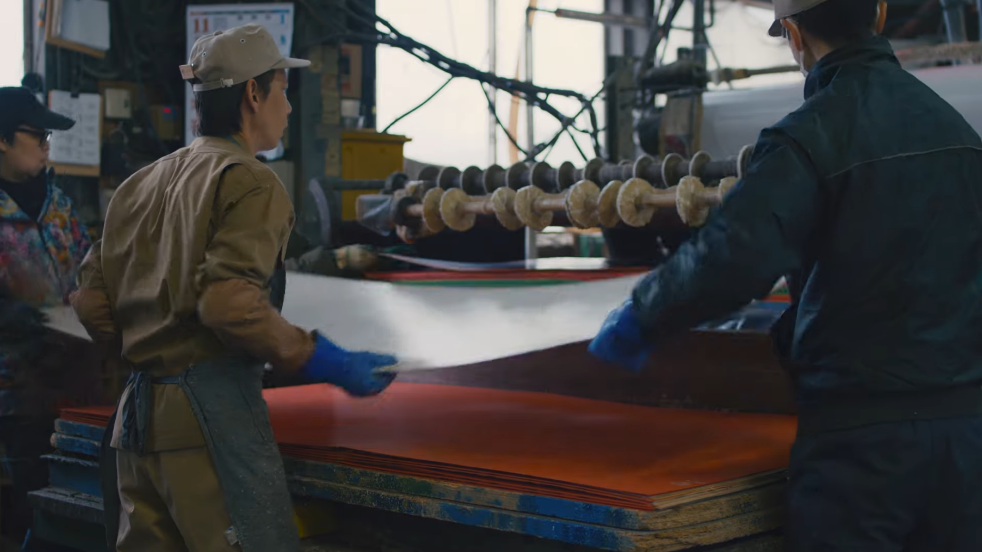
Building the material up in thin layers, with alternating grain directions and dense paper between them, reduces the movement that makes thin wood difficult to keep dimensionally stable.
But the construction is only part of the story. What interests me more is what happens once that construction becomes visible.
I founded “bosje” partly to explore this. Rather than hiding the layered structure under a surface finish, we let it become the design itself: the alternating wood and colored paper create stripes that run straight through the material, into its edges and cross-sections.
Nothing here is printed on. The stripes are the material.
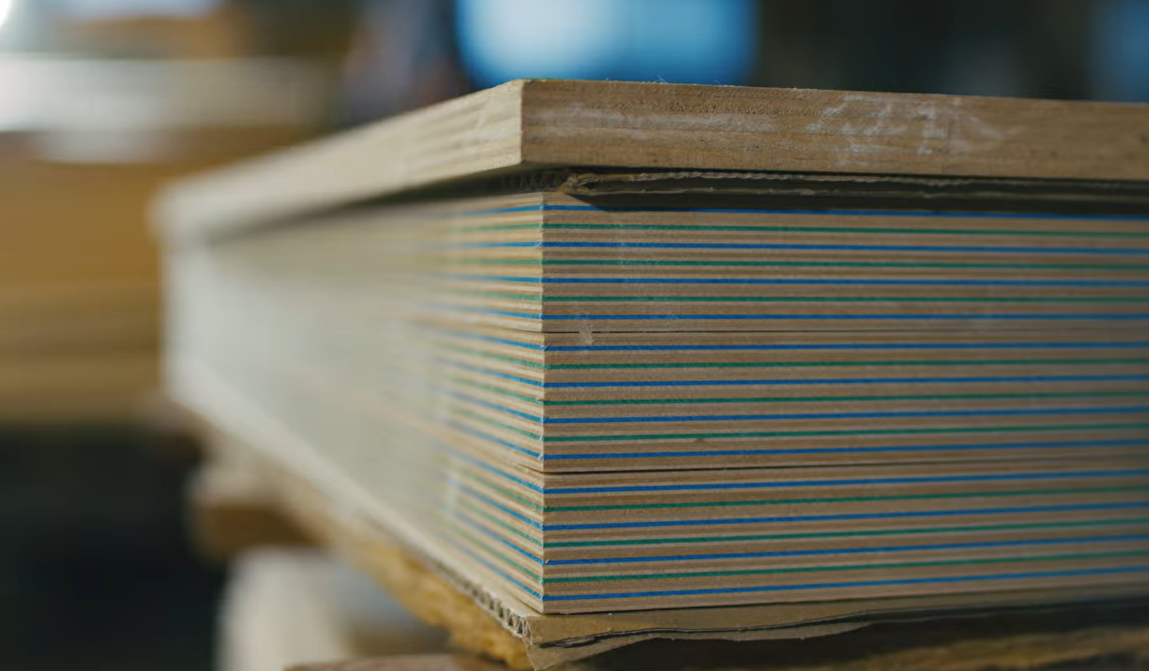
That distinction matters to me, because sustainability is so often presented as something that needs explaining — recycled content, certifications, carbon figures, end-of-life pathways.
Those things matter. But I think we sometimes forget a simpler reason people hold onto things: they like them.
A material can be technically responsible and still get thrown out if nobody wants to live with it. An object that's useful, durable, and beautiful enough to become part of someone's life is more likely to be kept — not as an environmental decision, but as the obvious thing to do.
This is where I think design has a role in circularity that's easy to overlook.
A stable material is less likely to warp, split, or become unusable. A repairable object stays in service longer. And an object whose visual identity deepens through use has a real chance of being kept rather than replaced.
None of this means recyclability doesn't matter — for plenty of products, separating and recycling materials is exactly the right answer.
What concerns me is when recyclability becomes the starting point of the design brief, ahead of durability, repairability, and whether anyone actually wants the object.
A product engineered to come apart easily may well be easier to recycle. But if getting there means compromising how it's built, how long it lasts, or whether it's worth keeping, it's worth asking what was actually gained.
Perhaps recyclability should be a safety net — not the destination we design toward from day one.
Because circularity isn't only about what happens after a product is finished. It is also about everything we can do to keep it from becoming finished in the first place.
I've spent much of my career thinking about how materials can become more sustainable. Working with wood taught me to ask a slightly different question: not just what happens to a material when it's finished, but what makes someone want to keep it in the first place.
That, I think, is where circular design should really begin — not at the point of disposal, but much earlier, with the question of why the object needs to get there at all.
Get the latest insights, trends, and innovations to help position yourself at the forefront of sustainable business leadership—delivered straight to your inbox.
Published Oct 15, 2026 9am EDT / 6am PDT / 2pm BST / 3pm CEST