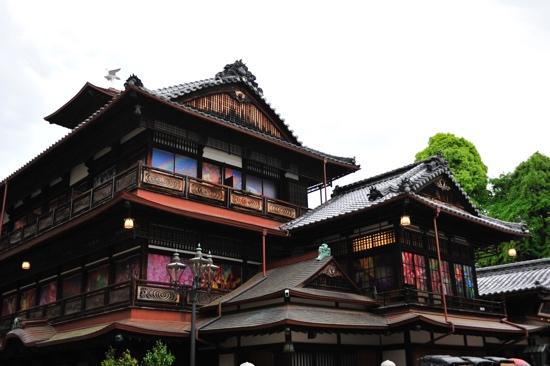
There are many stories left by those connected to Dogo Onsen, but none resonate today quite like Natsume Soseki's classic novel Botchan. Soseki frequented the Dogo Onsen Honkan and featured it in this work. The imposing building still stands today in all its splendor, just as the Meiji-era literary giant described it.
To ensure that the history, culture, architecture, landscapes and stories of Japan's oldest hot spring continue on for another next millennia, the town of Dogo Onsen is embracing cutting-edge art and technology as it embarks on a new era of reform.
Town Development Driven By The Community
Hot spring towns can be affected by many factors — external factors like economic downturns, soaring prices, natural disasters, infectious diseases and declining birth rates, and internal factors like staff shortages and aging facilities. Dogo Onsen is no exception. Despite its fame in Japan, the town faced a critical situation starting in 2020, when the number of visitors halved during the COVID-19 pandemic.
The Dogo Onsen Pride in Community Development Promotion Committee has been leading town development efforts to solve these challenges and create a stronger, more attractive area. Established in 1992, the organization is formed of traditional ryokan inns and hotels in the Dogo area, as well as shopping district associations, local residents, and companies and universities in Matsuyama City, where Dogo Onsen is located.
Mitsuhiko Miyazaki, the chair of the Promotion Committee and owner of several ryokans and hotels in Dogo Onsen, reflects on the early days of the organization. “The Committee was established to bring the community together to solve local challenges and improve the town. This movement was directly triggered by signs of decline after the burst of the bubble economy. Even back then we were keenly aware of one issue specific to Dogo Onsen, which was that it depends too much on the fame of the Dogo Onsen Honkan. It was up to the community to find a way to overcome this. We felt that, without change, Dogo Onsen would become another tourist destination that simply lives off its past. That might be fine now but thinking about the legacy that would leave future generations, we just couldn’t ignore the issue.”
Construction of the Dogo Onsen Honkan was completed in 1894 as part of renovations of the town’s aging hot spring facility. Then-mayor Yukiya Isaniwa championed its design by insisting that “to make a true mark, we need to build something that can’t be replicated — even 100 years from now.” The result is a three-story wooden building renowned for its imposing, majestic appearance, featuring two bathing areas and four kinds of relaxation rooms. The mayor’s insight proved correct: the Honkan has long served as a symbol and source of prosperity for Dogo Onsen. In 1994, it became the first public bathhouse to be designated a National Important Cultural Property.
Dogo Onsen now aims to become a sustainable hot spring destination by reducing its dependence upon both the historically and architecturally valuable Honkan, and the hot springs themselves. This seemingly counterintuitive policy was announced in 2024 by the Promotion Committee as the Dogo Onsen 2050 Vision.
The Dogo Onsen 2050 Vision
The Dogo Onsen 2050 Vision represents the town’s next step and was unveiled as restoration works on the Dogo Onsen Honkan were completed and the world entered the post-COVID era. Amid accelerating socio-economic and technological changes, the Promotion Committee conducted research, analysis and discussion on what Dogo Onsen should aspire to be in 30 years’ time and established this vision as a concrete guide to future change. The vision is twofold: to become a sustainable hot spring destination that doesn’t rely only on its hot springs, and to become a “digital hot spring city” where visitors from around the world can enjoy their stay in a variety of ways.
One factor behind this vision is inbound tourism, which is becoming crucial to the Japanese economy. Miyazaki explained the connection between the Dogo Onsen 2050 Vision and tourism from abroad.
“Dogo Onsen has a lower inbound tourism rate than other destinations. It currently stands at around 13% but was only 4% before the pandemic. As Japan’s population declines, attracting these tourists is becoming essential, and our vision sets a goal of increasing this rate to 50% by 2050. So, we asked, what kind of town could make this happen? This led us to two concepts: a sustainable hot spring town where bathing isn’t the focus, and a digital hot spring city. Baths are a vital resource, and that will not change. But what is needed now is local development that doesn’t rely on them alone. If we could attract visitors to the town with things besides the hot springs, and then additionally capitalize on them, it would surely give Dogo Onsen incredible appeal.”
Planning For the Next Decades In Order To Last For A Millennia
Miyazaki calls the Dogo Onsen hot spring both “waters of renewal” and “waters of reform.”
“In ancient times, the legendary Shotoku Taishi (Prince Shotoku) is said to have bathed in the waters of Dogo and conceived the Seventeen-Article Constitution and the Twelve Level Cap and Rank System, both of which shaped the early Japanese state. That was political reform. Then there is Ippen Shonin, the monk born in Dogo during the Kamakura period who famously made Buddhism accessible to ordinary people. That was religious reform. Finally, there is the reform of literature brought about by Natsume Soseki and Masaoka Shiki, who both frequented Dogo. It’s a stretch, but you could say that Dogo Onsen was involved in these three pivotal moments. By unraveling how the springs have become a part of and developed alongside the area’s history and culture, and presenting this in a clear and accessible way, we hope to create a valuable experience for people from Japan and around the globe. We’d like to be a town that embodies Japan’s hot spring culture and is open to the world.”
The tradition of Dogo Onsen has never been about living assets such as its hot springs and history, but about consistently innovating and taking on challenges in pursuit of new ideas.
Yukiya Isaniwa envisioned Dogo Onsen Honkan lasting for the next 100 years, yet 2014 marked the 120th anniversary of its reconstruction. It appears that the true tradition of Dogo Onsen lies in taking action not just for the present, but also for the decades and even centuries to come.
The Dogo Onsen 2050 Vision focuses on the next 30 years, yet also has the potential to serve as the spark for innovation with long-reaching impact — perhaps into the next hundred or even several hundred years. That innovation may be the first page of a new story that continues for the next millennium.
Get the latest insights, trends, and innovations to help position yourself at the forefront of sustainable business leadership—delivered straight to your inbox.
SUSCOM
Published Sep 2, 2026 9am EDT / 6am PDT / 2pm BST / 3pm CEST