Improving construction site environments through off-grid mobile houses
Shigetaka Hirosato, Board Director and President of Off-Grid Field Co., Ltd., founded the company out of a desire to transform conditions at construction sites, and Takahisa Yashiro of Hitachi High-Tech led the integration of the self-sustaining power system used in Off-Grid Field’s mobile houses. The result was Off-Grid Field, a joint venture between Takenaka Corporation and Croco Art Factory Co., Ltd. that was created to support workstyle reform and productivity by deploying off-grid mobile houses equipped with independent power systems and satellite communications. The goal: improve safety, comfort, and the image of construction work overall.
“Our starting point was simple,” Hirosato explains. “If we improve the on-site environment first, more people may take interest in the construction industry. Temporary offices like prefabs require significant effort just to set up air conditioning, toilets, communications, and supplies. Supervisors end up spending too much time on these logistics, leading to longer hours.”
Traditional temporary facilities also fall short on comfort and safety. In summer, heatstroke risks are high, and securing private clothes-changing areas can be difficult. Seeking a better solution, the team developed the concept of off-grid mobile houses, pre-equipped with air conditioning, toilets, and supplies, ready to deploy with minimal effort. Thanks to insulated construction and efficient energy systems, the units provide stable cooling even in harsh summer conditions. This makes them a strong option for preventing heatstroke and enhancing worker safety on-site.
Flexible collaboration enables rapid system improvements
Because off-grid mobile houses require power without external sources, the challenge is building a safe, low-cost system that fits within tight spaces and varies by installation site. “We initially tested a low-cost storage battery paired with solar panels,” Yashiro says. “But once operations started, concerns arose about charging reliability and output stability.” Hitachi High-Tech responded quickly, replacing all storage batteries with high-durability automotive-grade cells. “We’re still exploring the market and learning where demand will emerge,” Hirosato notes. “We prefer a trial-and-error approach, acting quickly even if some uncertainty remains. Trying to engineer perfect precision from the start tends to increase size and cost. Hitachi High-Tech’s responsiveness was a tremendous help.”
The off-grid park concept: Combining disaster preparedness with community value
Beyond everyday work environments, Off-Grid Field sees potential for mobile houses in disaster response. Under normal conditions, the units serve as temporary offices and rest areas; during emergencies, they can function as shelters or support hubs — without modification. Standalone power and communications are major advantages when lifelines fail. “The Off-Grid Park concept also positions these sites as community hubs, not just disaster-preparedness assets, right?” Yashiro asked during the conversation.
“Yes,” Hirosato replied. “The Off-Grid Park is both a rental base and a demonstration site where companies can test off-grid technologies. It’s also a place where students and local residents can learn, experience the systems firsthand, and gather as a community space. We hope it becomes a welcoming place that raises public awareness.”
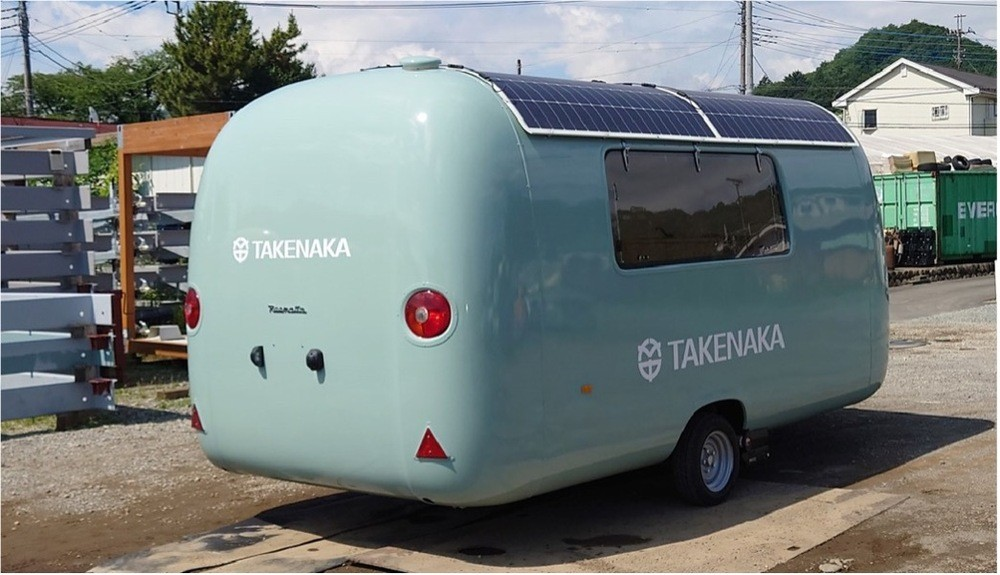 Image credit: Off-Grid Field. Off-grid mobile house. Even in locations without developed electric or communication infrastructure, independent power operation is possible through solar panels, storage batteries, and control devices, as well as satellite internet (Starlink)
Not only is setup simple, but, thanks to its insulated structure, the house provides ample cooling even in summer, making it excellent in terms of environmental performance as well. Mobile houses that leverage off-grid technology are an ideal solution to thoroughly prevent heatstroke and ensure safety.
Experiencing flexible collaboration and quick response through the implementation of self-sustaining power systems
Off-grid mobile houses are required to have a mechanism that supplies power without relying on external sources. The key is how to build a safe, low-cost system within tight indoor spaces and under installation-site constraints.
“Initially, we conducted a trial operation combining low-cost battery storage suitable for light use with solar panels. However, once we began operation, there were concerns about the reliability of charging and output stability.” (Mr. Yashiro)
Hitachi High-Tech responded quickly to these issues and ultimately replaced all the
storage batteries with high-durability automotive cells.
“Since we are still in the phase of market development while watching what kind of demand there is, what we seek is more of a trial-and-error style—acting first while anticipating some uncertainties. If we aim for perfect precision from the start, both size and costs go up, and it tends to become over-designed. In that regard, your proposal and responsiveness were a real help.” (Mr. Hirosato)
The off-grid park concept: Combining disaster preparedness with community value
Beyond everyday work environments, Off-Grid Field sees potential for mobile houses in disaster response. Under normal conditions, the units serve as temporary offices and rest areas; during emergencies, they can function as shelters or support hubs — without modification. Standalone power and communications are major advantages when lifelines fail. “The Off-Grid Park concept also positions these sites as community hubs, not just disaster-preparedness assets, right?” Yashiro asked during the conversation.
“Yes,” Hirosato replied. “The Off-Grid Park is both a rental base and a demonstration site where companies can test off-grid technologies. It’s also a place where students and local residents can learn, experience the systems firsthand, and gather as a community space. We hope it becomes a welcoming place that raises public awareness.”
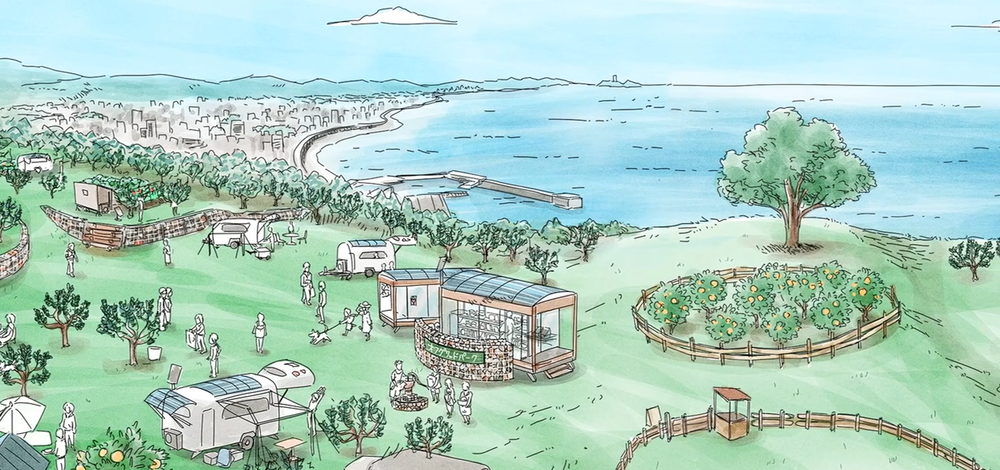 Image credit: Off-Grid Field. Off-grid Experience Park Odawara conceptual image (Partial opening planned by the end of 2025, full opening in 2027)
Building a sustainable future through partnerships
Off-Grid Field is now planning a “third vehicle” to follow its current mobile and trailer houses, and aims to move from one-off production to future mass-production in collaboration with Hitachi High-Tech. “For us, it’s incredibly meaningful to partner with organizations like yours that directly confront social issues,” Yashiro says. “We don’t just provide solutions — we help shape ideas from the earliest stages. With more than 3,000 clients in Japan and abroad, we hope to continue collaborating and expanding this work.” Hirosato sees the vision extending even further: “My goal is to become a city-building mobility company. These solutions support communities during disasters, but in everyday life, I want to create sustainable, open hubs where people gather and interact. By working with Hitachi High-Tech, we aim to deliver new value to society.”
Learn More
This conversation between Mr. Hirosato and Mr. Yashiro is also featured in Sustainability Book 2025, published by Hitachi High-Tech.
Get the latest insights, trends, and innovations to help position yourself at the forefront of sustainable business leadership—delivered straight to your inbox.
SUSCOM
Published Dec 10, 2025 11am EST / 8am PST / 4pm GMT / 5pm CET