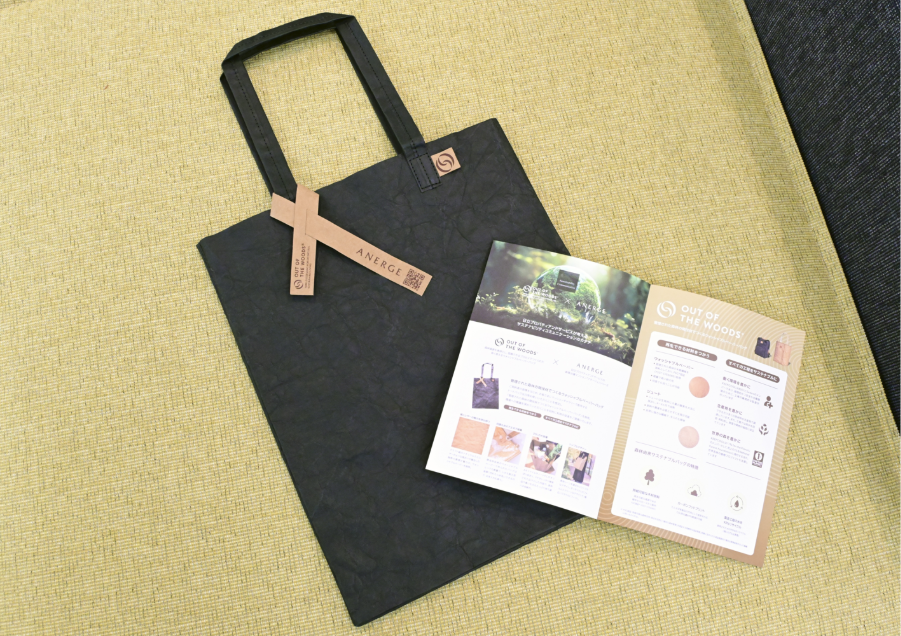
Part of the Hitachi Group, Hitachi Property and Service, Ltd. specializes in the sale of condominiums and single-family homes, as well as real estate leasing and brokerage in Japan. In 2026, the company began giving new condominium buyers tote bags made from thinned timber-derived washable paper to hold their contracts and other property-related paperwork. Employees also received the same bags to promote the circular economy within the company.
Four project members shared their insights into the initiative, which not only incorporated tools that help reduce environmental impact into the business, but also created opportunities to deepen environmental awareness among customers and employees.
A bag with an understated, durable design that helps reduce environmental impact
It all started in early 2024 when Hitachi Property and Service embarked on a new project to promote the circular economy. Reflecting on the endeavor’s early days, project member Kazuki Ogura explains what led them to choose paper bags.
"We thought long and hard about what we in the company’s condominium business could do to promote the circular economy. We first thought of service-based ideas, but then someone suggested creating something tangible instead. In the end, we decided to go with bags made from OUT OF THE WOODS®︎ washable paper.”
What mattered most was finding an approach that would also get customers thinking about environmental issues. By showing how the company thinks about and acts on everyday environmental issues that are within reach, they wanted to convey that Hitachi is committed to shaping the future through these small actions.
“When purchasing a condominium, customers receive a substantial amount of paperwork, so it is important that the bag is durable. In addition, its understated look and feel, which does not appear inexpensive, made it a good fit as part of the condominium’s branding,” says Atsuhito Yasukawa.
Yuka Akagi, who personally handed the bags to customers, recalls their reactions at the time:
“What left the strongest impression on me was a customer saying, ‘It’s amazing to see how seriously Hitachi is approaching these initiatives. It’s just like Hitachi to pay attention even to the materials used for its eco-bags.’ It made me realize once again that people have an image of the Hitachi Group as being actively engaged in sustainability, including environmental initiatives. While I felt proud of that, I also found myself wondering whether we are truly as environmentally conscious as we believe we are, and whether we are really taking actions that are good for the environment.”
Akagi’s question was also reflected in the results of a survey conducted when the bags were distributed to company employees.
Survey insights that spark the first steps toward change
The circular economy project team distributed the same bags to their fellow employees so that they could experience the material texture and utility firsthand. Another goal of the project was to raise awareness of forest-related environmental issues as a company that works with real estate developed using forest resources. To this end, they conducted an employee survey to understand more about their environmental awareness and behavior.
“We asked questions such as, ‘Are you familiar with the circular economy?’, ‘Do you engage in environmentally conscious behaviors?’, and ‘Do you actually purchase environmentally conscious products?’ Nearly half of the employees answered ‘yes’ to the first question, but more respondents selected ‘neither’ for the subsequent questions. This suggests that although employees have knowledge and information about environmental issues, these do not necessarily translate into environmentally conscious actions or purchasing behavior,” says Ogura.
Moving from awareness and interest to actually changing one’s behavior is not easy. That is precisely why using a bag—something people see and use in their daily lives—as a way to convey messages about environmental issues is so meaningful.
While these efforts have yet to fully translate into action, Ayaka Tabira noted that some younger employees in their 20s and 30s clearly responded that they are already taking action. The results also suggest that there is potential for further change in the future. The next generation is likely to play a central role in efforts to reduce environmental impact and advance the circular economy, accelerating progress in these areas.
Through this project, Hitachi Property and Services is working together with its customers to think and take action on environmental issues in ways that are close to everyday life, steadily connecting these efforts to a more sustainable future.
Related Links
Get the latest insights, trends, and innovations to help position yourself at the forefront of sustainable business leadership—delivered straight to your inbox.
SUSCOM
Published Oct 7, 2026 9am EDT / 6am PDT / 2pm BST / 3pm CEST