Automakers including
BMW,
Ford,
Renault
and
Volkswagen
are among those already seizing economic and operational benefits by expanding
circular manufacturing processes and supply chain partnerships. Now, in a time
of ever-growing economic and geopolitical
instability,
three of their peers are increasing operational resilience by driving the
movement forward.
Volvo cutting CO₂ emissions with recycled steel partnership
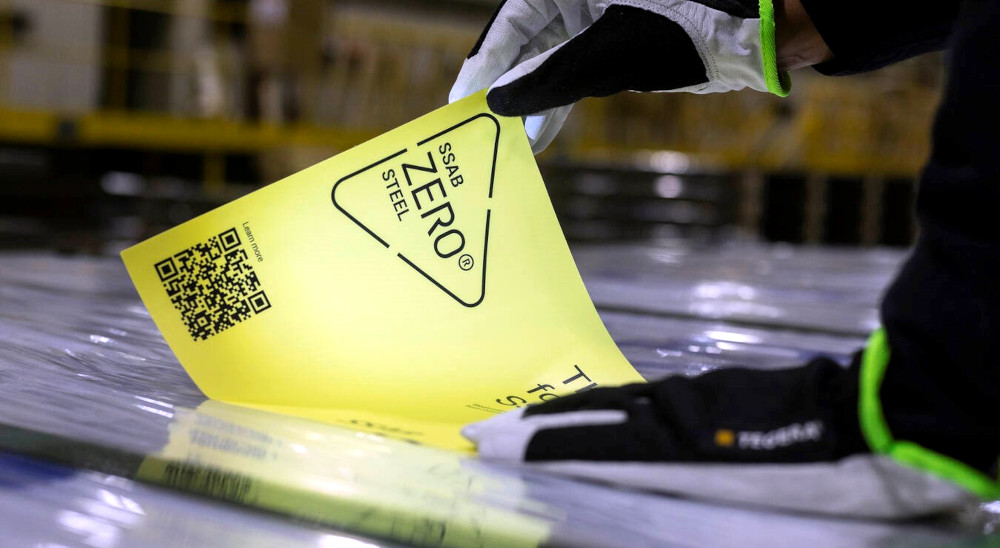 Image credit: Volvo
Cars
Image credit: Volvo
Cars
Volvo Cars has signed a new agreement with Swedish
steel firm SSAB for the supply of high-quality,
recycled and near zero-emissions steel starting from 2025. Volvo is the first
car maker to partner with SSAB for recycled, near-zero-emission steel for serial
production deliveries.
One of our most used materials, the steel industry produces over 1.8 billion
metric
tons
annually. Sadly, it is also a massive polluter: Traditional steelmaking
processes
rely heavily on carbon-intensive equipment such as blast furnaces, emitting
around 1.8 tons of CO2 for every ton of steel
produced
— roughly 11
percent
of the world's total greenhouse gas output.
“One of the biggest sources of CO₂ emissions in our production process is the
steel we use to build our cars, averaging 25 percent of all material-related
emissions for a new Volvo car,”
says
Chief Supply Chain and Manufacturing Officer
Francesca Gamboni. “We
work towards achieving net-zero greenhouse gas emissions by 2040, and cutting
steel-related emissions really has the potential to move the needle.”
The recycled steel — which meets the same safety-related requirements as primary
steel in terms of strength and durability — will be used in components of
Volvo’s forthcoming, fully electric EX60 SUV, as well as other cars based on
its next-generation SPA3 car
architecture.
SSAB’s closed-loop system recycles scrap steel, significantly reducing CO₂
emissions and keeping materials and natural resources in use for longer.
Compared with traditionally produced steel in Europe, SSAB’s recycled steel
generates almost 100 percent less CO₂ emissions in own operations and is made
with a recycled content of almost 100 percent.
In addition to buying recycled and near-zero-emission steel, Volvo Cars will
also sell its scrap steel to SSAB to be recycled at the company’s mill in
Oxelösund into decarbonized steel. The agreement is an extension of a
long-term collaboration between the two companies, with the goal of leading an
industrywide transition to decarbonized steel.
“This agreement marks a significant milestone on our journey toward steelmaking
with virtually no fossil CO₂ emissions,”
says Asma
Manesh, Commodity Manager
Scrap at SSAB. “The conversion of our Oxelösund site will not only enhance our
production competitiveness but also enable us to cut emissions equivalent to 3
percent of Sweden’s total CO₂ output — and high-quality steel scrap is an
important factor in this equation.”
Volvo Cars is committed to achieving net-zero emissions by 2040. By 2030, the
aim is to have reduced CO₂ emissions per car by 65-75 percent compared to a 2018
baseline. The SSAB partnership supports this, as well as Volvo Cars’ circularity
ambitions — which include achieving an average of 30 percent recycled content
across the fleet by 2030, and for new car models released from 2030 to contain
at least 35 percent recycled or bio-based content.
Mercedes, Modern Meadow partner to scale bio-based, circular leather alternative
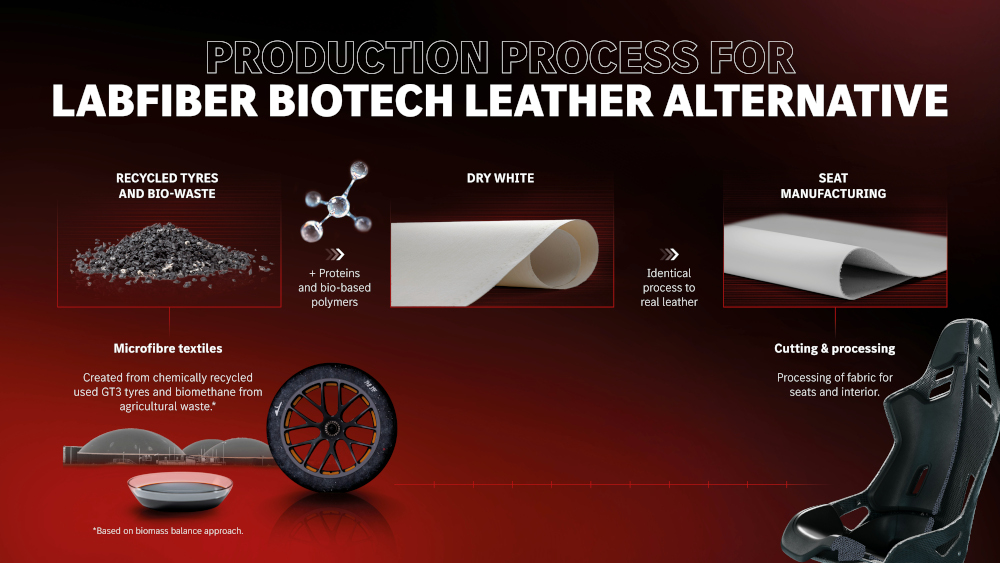 Image credit: Mercedes-Benz
Meanwhile, Mercedes-Benz has teamed up
with materials-science company Modern
Meadow
to develop a bio-based leather alternative for its Concept AMG GT
XX
technology program. The aim of the development partnership is to further develop
Modern Meadow's INNOVERA™ (fka
Bio-VERA™)
— a high-performance, upcycled alternative to traditional leather — for series
production and set new standards in vehicle interiors.
INNOVERA is made from a combination of plant-based proteins, biopolymers and
post-consumer waste to replicate the look and feel of conventional, bovine
leather. For the Mercedes-Benz partnership, the post-consumer waste component
will come from chemically recycled tires from Mercedes' AMG
GT3 race cars.
"At Modern Meadow, we are redefining automotive interior possibilities with
INNOVERA — our next-generation transformative material that brings beauty,
performance and sustainability into perfect balance," said CEO David
Williamson, PhD. "In
our development partnership with Mercedes-Benz, we have used INNOVERA to create
a new luxury leather alternative without sacrificing aesthetics, versatility and
texture. It looks and feels as good as it performs."
Modern Meadow's INNOVERA achieves more than 80 percent renewable carbon content
and is completely animal-free. INNOVERA requires no special preservation or
storage conditions, which reduces complexity and costs, and is adaptable to any
standard manufacturing process.
In the Concept AMG GT XX, one scrap tire provides the basis for approximately
four square meters of the custom INNOVERA material — which will be used as
covering for the black seat pads of the car’s bucket seats. Modern Meadow says its bio-based nature
makes it breathable, waterproof and lighter than traditional materials; and its maximum tensile strength is twice as high as that of
traditional materials.
JLR driving over £100m in value from industrial reuse initiatives
 Image credit:
JLR
Image credit:
JLR
And Jaguar Land Rover recently
revealed
how it is reducing waste across its industrial operations in the UK and Europe
through a £100m reuse, refurbishment, repurposing and recycling drive.
As its electrification transformation continues with the upcoming launch of
Range Rover Electric,
JLR’s industrial operations are readying themselves for the next generation of
electric vehicles and undergoing a revamp across all facilities.
As a result, tens of thousands of pieces of equipment and tools — spanning from
entire production lines to screwdrivers — have been put back in circulation,
when possible, after considering factors such as standard compliance,
availability of spare parts, cost of refurbishment and servicing, potential
scrap as well as sale revenues.
Instead of buying new, JLR has reused over 50,000 square meters of equipment —
from its facilities in Castle Bromwich, which ceased production last year, and
Graz, Austria; and its Electric Propulsion Manufacturing Centre
(EPMC) in Wolverhampton — and redeployed it across JLR sites in the
UK and Nitra, Slovakia. Meanwhile, hundreds of secondlife robots are now
installed at Solihull, Halewood and the Wolverhampton EPMC to produce
JLR’s next-generation electric vehicles and battery packs.
In addition, 18,600 tonnes of scrapped metal from Castle Bromwich and Graz have
been sent to a supplier for recycling — helping to enable the reduction of CO2e
emissions by 1,258kg per tonne of new steel generated from scrapped metal.1
“As we are entering a critical phase in our electrification journey, JLR aims to
act as a responsible user of resources by enhancing product utility and
longevity, and maximizing recycling and repurposing,” says Chief Sustainability
Officer Andrea Debbane. “It’s not
only the right thing to do, but it also improves profitability and increases
supply chain resilience. Through these initiatives, JLR advocates that
sustainable choices are not always more expensive — they can help reduce costs
and even become opportunities for the growth and development of our colleagues.”
JLR’s circularity drive has been led by a broad, crossfunctional group with
members from Industrial Operations through to Vehicle Programs working across
sites and technologies to identify asset reuse opportunities.
A new digital management system has also been developed inhouse, aiming to
manage the life of every vehicle program asset from acquisition through to sale,
scrapping and reuse. The solution will include an internal marketplace where a
catalogue of assets will be available for purchase, streamlining and scaling up
future projects. Across facilities, the teams have also built new technical,
maintenance and safety skills — bringing refurbishment and recalibration of
tools to production standards on site.
Circularity plays a major role in JLR’s transformation in becoming a more
sustainable, modern luxury business. Other circularity efforts include a
partnership with energy
giant Pramac
to develop a portable, zero-emission energy storage unit powered by second-life
batteries from the all-electric Jaguar
I-PACE.
1Supplier data: 442kg CO2e per tonne of new steel created from scrapped metal
vs 1,700kg CO2e per tonne of new steel created from scratch (as of 29th April
2025).
Get the latest insights, trends, and innovations to help position yourself at the forefront of sustainable business leadership—delivered straight to your inbox.
Sustainable Brands Staff
Published Jul 8, 2025 8am EDT / 5am PDT / 1pm BST / 2pm CEST