Global beauty brands including Eucerin, Garnier, L’Oréal Paris,
Neutrogena, Nivea, Schauma and more have begun publishing their
EcoBeautyScore — the first global,
science-based environmental scoring system for cosmetics and personal care
products — in select markets across Europe and UK.
Developed over three years by the not-for-profit EcoBeautyScore
Association — in collaboration with over 70
cosmetics and personal care companies and associations — the scoring system
offers brands and retailers a clear, transparent and consistent way to measure
and communicate the environmental footprint of beauty products. Rooted in the
EU’s Product Environmental
Footprint
methodology, EcoBeautyScore rates products from A to E according to their impact
on land, water and air over the full lifecycle of the product.
It’s projected that consumers will spend more than $150 billion on beauty
and personal care
products in
Europe in 2025, with demand for more sustainable options on the rise. However,
half of European consumers remain skeptical of brands’ sustainability
claims
— suspecting they don’t accurately
reflect
the real environmental impact of products.
Against this backdrop, the EcoBeautyScore offers a timely and practical solution
— translating complexity into a scientifically robust, yet accessible scoring
system. The rigorous measurement process evaluates a product’s environmental
impact across its entire lifecycle — analyzing everything from ingredient
sourcing and packaging materials to how a product is used and disposed of.
Consumers can find participating brands’ EcoBeautyScores on their websites;
on-product labeling will be available in Europe in late 2025.
The EcoBeautyScore methodology and platform have been reviewed and verified by
external experts, and brands using the scoring system will be regularly audited
and certified by an independent third party. Consumer demand for this kind of
transparency is already strong: In a global Ipsos study⁴ of more than 9,000
consumers across Brazil, China, France and the US, more than
two-thirds say the EcoBeautyScore label builds trust; and the majority intend to
take the EBS score into consideration for purchases.
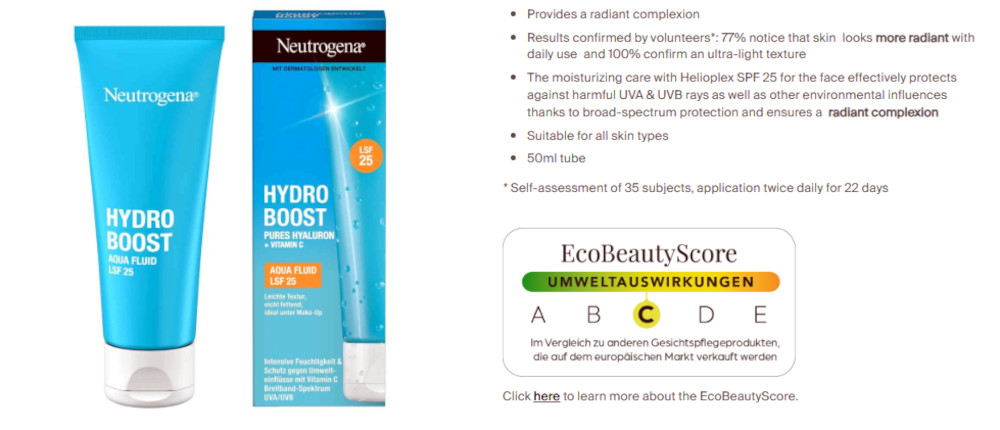 Image credit: Neutrogena
“EcoBeautyScore gives the beauty industry the transparency tool it has long been
missing,” says Jean-Baptiste
Massignon, Managing Director of the
EBS Association. “For the first time, brands can communicate their environmental
impact in a way that is science-based, consistent and easy for consumers to
understand. Through a simple-to-use scoring platform, companies have access to a
wealth of data about the environmental hotspots of their products — making it
accessible for brands of all sizes, no matter their sustainability expertise.
“It’s encouraging to see pioneering companies begin publishing their scores; it
marks an important milestone of collective openness and accountability across
the sector,” Massignon added. “We know this won’t happen overnight, but this is
how progress starts: with a shared framework, honest data and a commitment to
informing better choices for the planet.”
After years of development and testing, the EcoBeautyScore system is now being
applied to four product categories: shampoo, conditioner, body wash
and face care products. It’s open to all cosmetics and personal care
manufacturers, with early adopters already publishing scores and more expected
in the coming months. The system is free to trial and comes with onboarding
support for brands of all sizes. Launching first in Europe, it will gradually
expand worldwide and cover the full range of beauty products.
Brands which have published scores so far include:
Eucerin and Nivea
Q10
(Beiersdorf), Garnier and L’Oréal Paris (L’Oréal), Neutrogena (Kenvue), and
Schauma (Henkel).
“We are thrilled to see the hard work of the past years result in such a
concrete and unique tool,”
says
Dr. Gitta Neufang,
Chief R&D Officer at Beiersdorf. “This joint initiative is a significant step
forward, and we are grateful for the collaboration across more than 70 industry
partners. It will create a lasting impact and positive change.”
The EcoBeautyScore was also shaped by lessons learned from founding member
L'Oréal's Product Impact Labeling
system,
rolled out in France in 2020 and the US in 2022, which gave consumers the
relative environmental impact of each product compared to other L'Oréal products
in the same category. The cosmetics giant transitioned from its own
product-impact labeling to the EcoBeautyScore when it became available in late
2023.
“Calculating the environmental impact of a beauty product is an inherently
complex process that has traditionally required expert analysis,” says
EcoBeautyScore Scientific Director Laurent
Gilbert. “What we’ve done
with EcoBeautyScore is distill that complexity into a scientifically robust, yet
accessible scoring platform.
“Grounded in the methodology recognized by the European Commission as the most
effective to measure environmental footprint, it evaluates a product’s impact
across 16 dimensions — including carbon emissions, water usage and resource
depletion. This level of detail gives brands and retailers a clear understanding
of areas for improvement, while providing consumers with a simple, transparent
score to guide more sustainable choices. It is both technically rigorous and
easy to understand, and that combination is what makes it a powerful tool for
driving progress in the beauty industry.”
Beauty brands and manufacturers interested in joining the movement toward
greater transparency can access a free trial of the
EcoBeautyScore system here.
1,4 Ipsos study, Assessing Consumer Interest Best Design And Narrative
EcoBeautyScore – March 2023
Get the latest insights, trends, and innovations to help position yourself at the forefront of sustainable business leadership—delivered straight to your inbox.
Sustainable Brands Staff
Published Jul 23, 2025 8am EDT / 5am PDT / 1pm BST / 2pm CEST