Although there aren’t clear numbers on how many reusable plastic drink bottles
are sold in the US annually, the market is estimated to be somewhere in the
range of $47-48 billion. The data also isn’t clear on how that’s divided
between single-use
bottles
(such as those sold in multi-packs) and sturdier, multi-use bottles — such as
those produced and sold by Colorado-based athletic water bottle maker
Hydrapak.
In the latter category, Hydrapak makes a number of hard, squeezable and
collapsible bottles using polypropylene (PP) and low-density
polyethylene (LDPE) — two more durable, yet flexible, types of plastic
than the PET used for single-use
bottles;
and common materials used by major brands for bottling beverages such as
Gatorade and Powerade.
“We found that our contribution could be better to impact the specific set of
materials we use,” HydraPak CEO Matt
Lyon told Sustainable
Brands® (SB). “[So, we asked ourselves,] how could each one of our
products use more recycled content?”
In 2024, the company piloted its
‘RePak’ program at a
select number of HydraPak retailers near its home base in Boulder, Colo and
at five athletic events. Cardboard receptacles were placed at various retail
locations, races and other events to collect worn-out squeezable bottles from a
range of brands.
In all, the company collected 900 bottles — diverting 170 pounds of plastic from
the landfill and learning a lot about how to actively engage its customers in
the recycling process.
“Events weren’t great, because customers weren’t bringing the bottles [for
recycling],” Lyon said. “With retailers, the longer those bins could be in the
stores, the better [to drive awareness].”
Once a bin was full, retailers would send the material to HydraPak — which would
then separate caps from bottle bodies and remove padded insulation from
insulated bottles before sending to local plastic recycler
Eco-Cycle for processing. According to business
operations director Justin
Stockdale, the
organization collects 27 hard-to-recycle materials and also runs a hauling
service that extends as far south as Fort Collins, Colo. He’s at the front
line of determining how to process the materials and who their next users would
be.
“There is an endless sea of demand for clean, not yogurt-lid PP and LDPE,”
Stockdale told SB. “Brands are really interested in producing their content out
of recycled material, but general recycling doesn’t produce a product clean
enough that can be reused.”
Case in point: HydraPak’s Recon™ line
of bottles is made from 50 percent recycled content, but not its own — the
recycled component is made from specialty producer Eastman’s Tritan™
Renew
copolyester.
A promising start
Meanwhile, both Eco-Cycle and HydraPak saw promise from the pilot — so the
program has been formalized for 2025. Lyon said this year, they’ll have
collection boxes at 47 retailers in a handful of states — hoping to expand to as
many as 100 separate locations with up to three boxes at each.
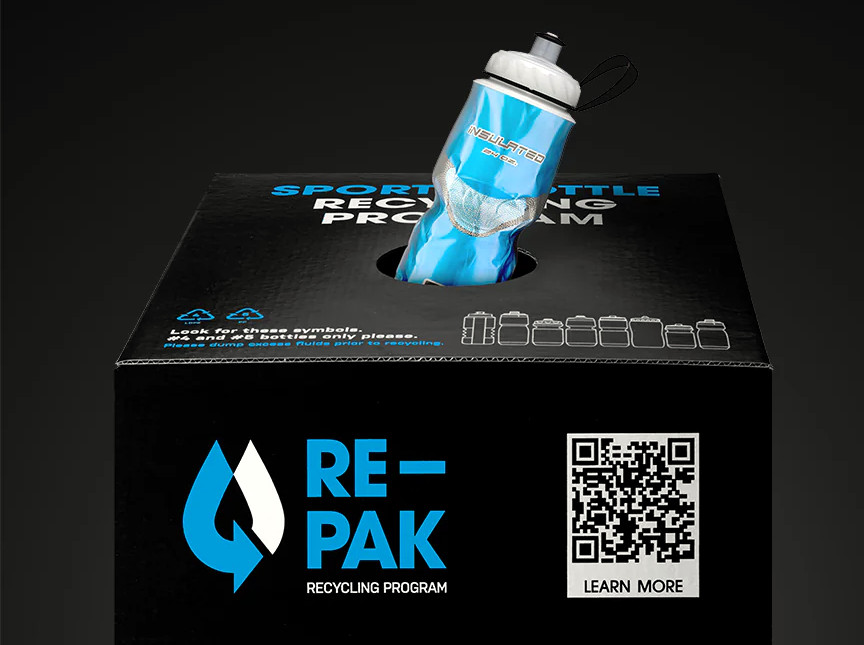 Image credit: HydraPak
Once HydraPak passes the material to Eco-Cycle, it processes the PP and LDPE to
prepare it for one of three streams: Two options are for more traditional,
middle-man resellers of granulated material; the third goes to companies such as
Trex Decking — one of the country’s largest decking
material producers — which purchases a certain amount of the recycled plastic to
add into a mix to create composite decking products, similar to an existing
process it uses to incorporate recycled plastic film into production. (SB
reached out to Trex to learn more about where it sees potential with PP and
LDPE, but the company declined to comment on what it calls a “proprietary”
process.)
Supply vs demand
Back at Eco-Cycle, Stockdale said the RePak model is promising — but there would
have to be a much larger supply of spent PP and LDPE to create a stable supply
chain for the recycled resins. Even at full output, HydraPak could not supply
the amount of material a company such as Trex would want to buy. There are also
only a few processing plants around the country that can handle a sizable volume
of PP and LDPE, even if it were to become available.
“We don't know if we’ll see volumes (of the LDPE and PP) spike, if it will be a
slow roll or if there will be any interest,” Stockdale said. “I am optimistic
that if we were able to turn out 40,000 lbs. of material, we could do something
— but today, I don’t have that.”
The other issue Stockdale raised is that composite
decking
such as Trek’s is ultimately not a circular solution: Once the decking material
reaches the end of its useful life, there’s no way to separate the integrated
recycled plastic from the other materials — so, it’s likely the old decking
would eventually go to the landfill.
For now, even with the expansion of programs such as RePak, the numbers are too
small to better understand a potential trajectory. Stockdale said it’s also
going to require a level of consumer buy-in that may or may not be there
yet.
“There’s an expectation that this program will grow rapidly, but this is a great
test of consumer behavior,” he said. “Do people care enough?”
Achieving the desired impact will likely require conscious companies such as
HydraPak and Eco-Cycle to join forces with others — think, cross-industry
initiatives such as NextWave
Plastics
or partnering with nationwide recyclers such as Pact
Collective
— to provide the necessary supply to profitably meet demand for these kinds of
recycled materials.
In the meantime, interested retailers can learn more about adding RePak
bins to their stores — to
help HydraPak achieve its goal to collect four times more bottles for recycling
in 2025.
Get the latest insights, trends, and innovations to help position yourself at the forefront of sustainable business leadership—delivered straight to your inbox.
Published Jul 18, 2025 8am EDT / 5am PDT / 1pm BST / 2pm CEST