Nearly 800 million
people
— one in eleven globally — go to bed hungry each night. At the same time, a third of all food produced is lost or
wasted before it can be eaten,
costing the global economy over $1 trillion every year. Once discarded,
that waste contributes 8-10
percent
of global greenhouse gas emissions while depleting precious natural resources
including freshwater, soil nutrients and energy.
By 2050, food production will need to increase by 60 percent to feed a
projected population nearing 10
billion
— a demand our current systems, weighed down by inefficiencies and waste, are
not equipped to meet.
For decades, preserving fresh produce has relied on a small set of tools:
refrigeration, synthetic waxes, fungicides and single-use plastics. While these
can extend shelf life, they also come with serious environmental
trade-offs.
There’s no shortage of innovators working to address this: One group has worked
to make use of the food and agricultural waste our system generates — upcycling
it into everything from skincare
ingredients
and biobased
packaging
to animal
feed
— and another helps
hotels,
retailers
and
restaurants
redistribute excess food before it becomes waste.
A third group aims to protect the longevity of food before it even reaches the
market. One such innovator — California-based food tech company Apeel
Sciences — uses plant-based
coatings
to keep fresh produce fresher longer, without relying on plastic or synthetic
chemicals.
James Rogers founded Apeel
in 2012, shortly after he won the UCSB New Venture Competition while
completing his PhD in Materials Science at UC Santa Barbara, and soon
recruited fellow UCSB lab mates Dr. Jenny
Du and Louis
Perez. Although the team
didn't have any prior background in food or agriculture, they had learned about
the global food waste issue from UN FAO reports and wanted to apply their
science and engineering knowledge in skills to trying to help solve the problem.
But they wanted to take inspiration from nature — using materials and mechanisms
already used by plants — to develop solutions.
“Apeel Sciences began with the promise of developing safe, sustainable solutions
that extend the quality and life of fresh produce — making produce more
enjoyable and accessible to consumers, improving supply chain efficiency and
resilience, and reducing food waste worldwide,” CEO Luiz
Beling tells Sustainable Brands®
(SB). “It has been our mission from the beginning to do so in a way that
sustains our health and the health of our environment for this and future
generations.”
Slowing ripening, naturally
Apeel keeps fruits and vegetables fresher for longer by adding a protective,
plant-based layer that slows down spoilage. Now applied to fruits including
avocados, citrus fruits, cucumbers and mangos, Apeel’s thin, edible coating is
made from ingredients naturally found in the peels, seeds and pulp of plants —
the same kinds of substances already present in foods including avocado oil,
butter, bread and even infant formula.
“Our ingredients are non-GMO, responsibly sourced, free from regulated
allergens, and free of trans fats,” co-founder and head of regulatory Jenny
Du explains. “These are common food ingredients with a long history of safe use
— reviewed and approved by the US FDA, the European Food Safety
Authority and many others.”
Apeel’s invisible barrier works by slowing down dehydration and oxidation — the
two natural processes that cause produce to spoil. The result? Less waste,
better texture and flavor, and more time for consumers and retailers to enjoy
what they’ve paid for.
“Our products keep produce fresh and nutritious for longer,” Du adds. “That
extra time helps reduce food waste, save consumers money and cut down on the use
of plastic packaging.”
Since 2021, Apeel says its solution has helped save 166 million pieces of
fruit from going to waste, avoided 29,100 metric tons of CO₂-equivalent
emissions (the same as planting 485,000 trees) and conserved 6.96 billion liters
of water — enough to fill 2,800 Olympic-sized swimming pools.
Getting closer to the source
When Apeel first brought its product to market, the team focused on working
directly with retailers. The goal was to show that keeping produce fresher for
longer could reduce in-store shrink, improve customer satisfaction and help
retailers cut unnecessary
waste.
Over time, however, the company realised that its greatest opportunity for
impact was earlier in the supply chain.
Today, Apeel partners closely with growers, packers and shippers. These are the
people handling produce right after harvest, and they have the most influence
over how long that produce will last by the time it reaches consumers.
“We work with a wide range of grower, packer and shipper partners across the
globe,” Beling explains. “Many are using our product to extend freshness, reduce
shrink and improve operational efficiency.”
By focusing upstream, Apeel can help protect more of the harvest before it
enters the complex web of transport, storage and retail environments — which has
made it easier for supply chain partners to integrate Apeel’s coating into their
operations and get clearer results. When produce arrives at retailers in better
condition, everyone benefits.
The company’s expansion has largely been driven by performance and word of
mouth. Early adopters who see fewer rejections, longer shelf life and better
quality often share their results with others in the industry.
Addressing misinformation
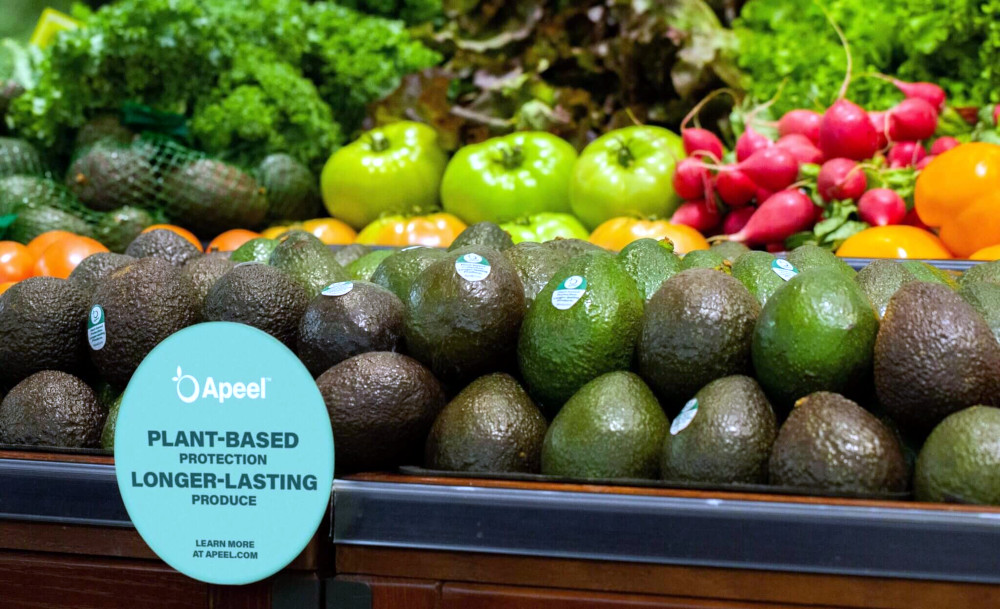 Image credit: Wicked
Leeks
Image credit: Wicked
Leeks
Despite its proven safety
record, Apeel has faced
disinformation
campaigns
— amplified by its decision to publicly label treated produce. Unlike
traditional post-harvest coatings, which are largely invisible, Apeel made the
intentional choice to disclose its process.
“We believed consumers would want to know what’s on their produce,” Beling
explains. “However, that public-facing brand visibility has had the downside of
making ourselves an easy competitive target to ‘take down,’ compared to other
post-harvest technologies (whether legacy players or new market entrants).”
The company now pairs transparency with education — not just relying on facts,
but working to build trust. That effort is bolstered by experts including Toby
Amidor, MS, RD,
CDN — a
registered dietitian who has studied Apeel’s ingredients.
“Mono- and diglycerides are building blocks of fat, but the amount used in Apeel
is so minute that you get minimal calories from it. These types of fats
naturally occur in all fruits and vegetables. For example, an avocado contains
21 grams of fat, and Apeel adds just 0.06 grams,” Amidor tells SB. “Fruits and
vegetables with Apeel are 100 percent safe to eat — they just have a microscopic
layer of lipids applied to the peel to keep the fruits and vegetables fresher
for longer. This means you get a few days extra to bite into or prepare your
favorite produce and minimize food waste in your own home.”
RipeTrack: Making freshness measurable
Apeel has also developed RipeTrack — an
AI-powered digital platform that gives retailers, suppliers and packers the
ability to measure ripeness and quality with precision. The platform uses a
handheld optical scanner, or spectrometer, to assess internal characteristics of
produce without having to cut it open — avoiding the waste typically caused by
manual quality checks.
The data collected (on firmness, dry matter and ripeness stage) is sent to a
cloud-based platform, where AI models analyze and predict how the fruit will
ripen over time. This gives buyers and merchandisers actionable insights into
when to move inventory, how to plan displays and the quality consumers can
expect at the point of sale.
“At its core, RipeTrack is about turning freshness into a science,” Beling says.
“It’s one more way we’re helping the industry reduce waste, increase access to
high-quality produce, and deliver on the promise of better food for more
people.”
According to a
study from the
University of Illinois Urbana-Champaign’s Applied Research
Institute, Apeel’s method of testing avocado ripeness is up to three times
more accurate than current industry testing mechanisms — giving retailers a far
clearer picture of fruit quality. Early RipeTrack users have already reported
improvements in quality consistency, less shrink and stronger category
performance.
A more resilient food system
As climate change intensifies and global food demand rises, Apeel sees its work
as part of a broader movement to build resilience into the food system. From
making fresh produce more accessible in markets with limited refrigeration to
supporting growers with more reliable quality tools, the company’s vision
reaches far beyond the supermarket aisle.
Beling asserts: “If we’ve done our job right, Apeel will be known not just for
extending shelf life — but for extending the impact fresh food can have on
health; on sustainability; and on creating a smarter, fairer, more abundant food
system for everyone.”
Get the latest insights, trends, and innovations to help position yourself at the forefront of sustainable business leadership—delivered straight to your inbox.
Scarlett Buckley is a London-based freelance sustainability writer with an MSc in Creative Arts & Mental Health.
Published Sep 2, 2025 8am EDT / 5am PDT / 1pm BST / 2pm CEST