Aviation is under pressure to clean up its act, and fast. The industry’s
flagship climate tool, the Carbon Offsetting and Reduction Scheme for
International Aviation
(CORSIA),
is already faltering. A new
report
has revealed that only one project has issued carbon credits eligible under
CORSIA rules. That’s a startling supply crunch for a scheme meant to help
airlines hit emissions targets by purchasing offsets, especially as
international flights ramp back up post-pandemic. With the voluntary carbon
market (VCM)
unable to keep pace, airlines could be flying into a serious climate credibility
gap.
CORSIA was never meant to be the entire solution. But this shortfall underscores
a deeper truth: Aviation can’t offset its way out to sustainability. Airlines
and aircraft manufacturers need viable, scalable ways to reduce emissions at the
source.
And while policy lags and viable jet fuel alternatives remain limited, the innovation
pipeline tells a more hopeful story: A surge of new technologies is reimagining
a sustainable future for aviation. Many are still early stage, but they point to
a future where the need for offsets shrinks, not grows.
Here are five standout solutions helping aviation cut emissions. Each one
tackles the problem from a different angle – and together, they offer a glimpse
of what cleaner flight could look like.
Ceramic fuel cells powered by liquid sodium could unlock electric flight
 Image credit: Gretchen
Ertl
Image credit: Gretchen
Ertl
A team at
MIT
has developed a liquid sodium metal fuel cell designed to overcome one of
electric aviation’s biggest hurdles: battery weight.
Instead of using traditional, rechargeable batteries, this system runs on
inexpensive liquid sodium and could deliver more than three times the energy
density of current lithium-ion tech. The goal? Make electric aircraft feasible
for commercial use, without the heavy baggage of today’s battery limitations.
How it works
The system is built around a solid ceramic electrolyte that separates liquid
sodium fuel from ambient air. Oxygen from the air reacts with sodium ions that
pass through the membrane, producing electricity in the process. Unlike
batteries, there’s no need for recharging – just refuel with more sodium. That
makes the setup not only lighter and more energy-dense, but also safer, since
the two reactive components are separated and one of them (air) is
non-combustible. The prototype is currently small, but scalable, and is being
further developed by a startup called Propel
Aero
based at The Engine – MIT’s innovation hub.
Why climate-conscious brands should care
Aviation consumed around 99 billion gallons of fossil fuel in 2024 alone and
remains one of the hardest sectors to decarbonize. If this technology scales, it
could help phase out fossil jet fuel entirely for short- and medium-haul
flights. That’s a major opportunity for climate-focused companies – whether it’s
greening business travel, decarbonizing supply chains, or investing in
breakthrough tech. It’s not just a fuel cell; it’s a potential route to net-zero
aviation.
Turning waste polystyrene into a critical SAF ingredient
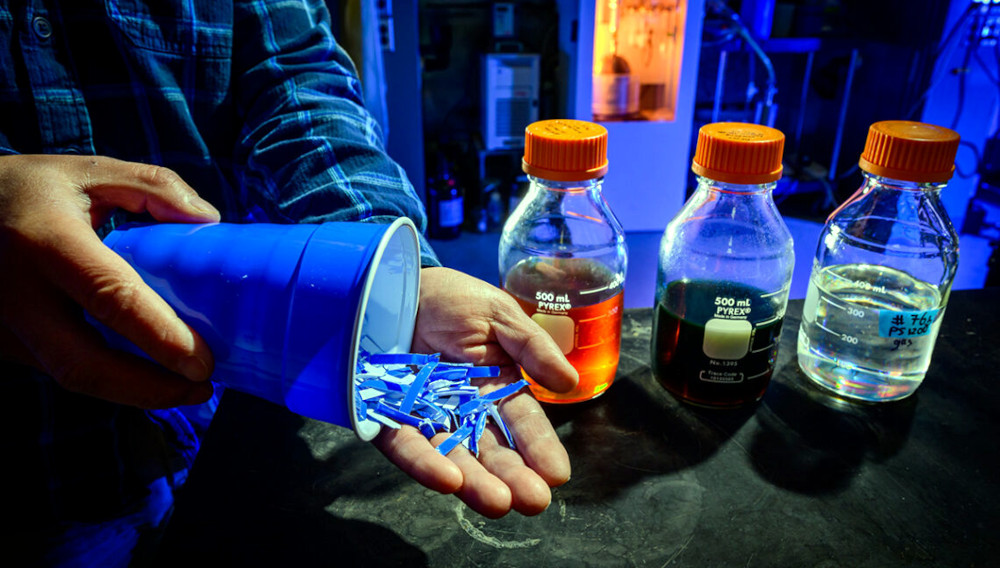 Image credit: Fred
Zwicky
Image credit: Fred
Zwicky
Researchers at the University of Illinois
Urbana-Champaign
have developed a method to convert waste polystyrene – the kind found in
packaging and
containers
– into ethylbenzene, a key aromatic hydrocarbon used in aviation fuel.
Aromatics make up 8-25 percent of jet fuel and are essential for ensuring proper
combustion and sealing within fuel systems. Sustainable aviation fuels
(SAFs) often lack sufficient aromatics, limiting their use. This
breakthrough could help unlock safer, more scalable SAF blends.
How it works
The process relies on thermal pyrolysis, where polystyrene is heated and broken
down into a styrene-rich liquid. The team then adds hydrogen to the mix,
producing crude ethylbenzene. After distillation, the result is a product that’s
90 percent pure and performs just as well as fossil-derived alternatives when
blended with SAF.
Even more impressively, a lifecycle analysis shows a 50-60 percent reduction in
emissions compared to petroleum-based ethylbenzene. It’s also cheaper to make.
Yes, it’s still at the lab stage; but the team is aiming to scale to continuous
pilot operations and is building partnerships for waste-stream sourcing and
sorting to ensure a steady supply of low-cost feedstock.
Why climate-conscious brands should care
This innovation checks multiple boxes: waste reduction, emissions savings and
better SAF performance. For companies relying on air freight or business travel,
it offers a real pathway to lower-carbon aviation. And for brands working toward
circularity goals, it’s a powerful reminder that today’s trash could fuel
tomorrow’s transport, literally.
Scaling up next-gen SAFs with ‘Aerobrew’
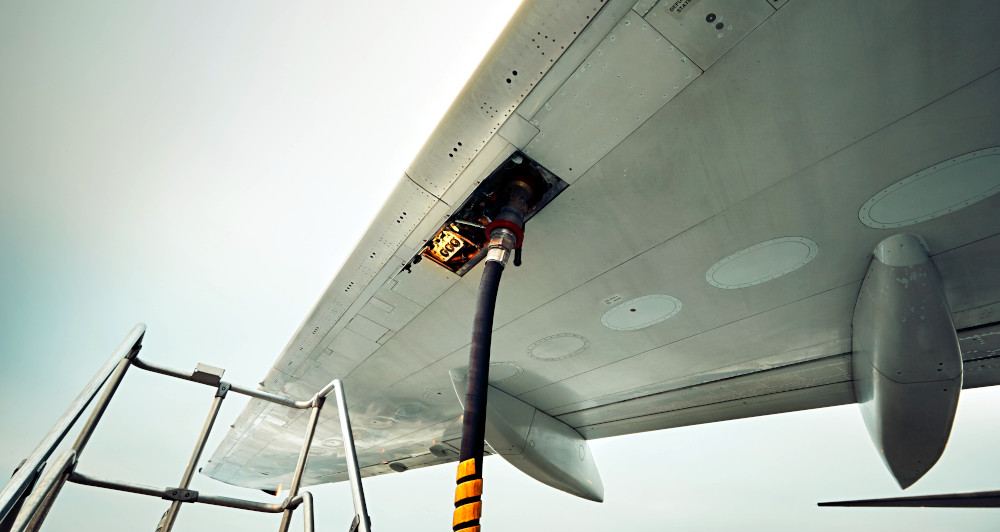 Image credit: Metafuels
Swiss startup Metafuels is pioneering a new process to
produce synthetic sustainable aviation fuel (e-SAF) at scale, using a system it
calls ‘Aerobrew.’ While SAF has long been recognized as a key to
decarbonizing aviation, high costs and low production
volumes
have held it back. Metafuels’ approach aims to deliver a higher-yield,
lower-cost alternative that could replace fossil jet fuel without modifications
to existing aircraft.
How it works
The Aerobrew process begins by combining green
hydrogen
– produced through renewably powered electrolysis – with captured CO₂, sourced
from technologies such as direct air
capture.
These inputs are used to synthesize green methanol, which is then converted into
SAF. Unlike other SAF production methods, Aerobrew maximizes conversion
efficiency from methanol to jet fuel, which significantly boosts yield and
reduces production costs.
The result is a drop-in fuel that works across all aircraft types, with no need
for changes to engines or infrastructure. Backed by $22 million in funding,
including a recent $5 million
grant
from the Swiss Government, Metafuels is now moving toward commercial scale. A
newly announced facility in Denmark, built in partnership with European
Energy, is expected to produce 12,000 litres of e-SAF per day.
Why climate-conscious brands should care
Aviation emissions are rising fast, and SAF remains one of the most promising
tools to counter them. But scalability is the sticking point. Metafuels offers a
real-world path to volume production of SAF, powered by renewables and carbon
capture. For brands with global operations, freight logistics or ambitious
climate targets, this innovation could enable cleaner skies without waiting
decades for electric or hydrogen planes to arrive.
Using AI flight planning to stop planet-warming contrails
 Image credit:
chamillewhite
Image credit:
chamillewhite
Contrails – those familiar white streaks trailing behind jets – are a
surprisingly potent climate threat. They trap heat in the atmosphere and are
responsible for up to 60 percent of aviation’s climate impact. Until recently,
avoiding them was considered too complex. But UK-based climate tech startup
Satavia is
proving otherwise. Its DECISIONX platform uses AI to help airlines plan
flight paths that avoid contrail formation – cutting emissions without requiring
new fuels or hardware.
How it works
Satavia’s system draws on high-resolution weather forecasting, aircraft
performance data and atmospheric modeling to predict where and when contrails
are likely to form. Built on its 5-DX digital twin of the atmosphere, DECISIONX
lets airlines reroute or adjust altitude just slightly – sometimes by as little
as a few hundred feet – to avoid the narrow atmospheric bands where contrails
form. These minor tweaks can prevent warming.
Importantly, the platform also quantifies the climate impact of these changes –
allowing airlines to validate and monetize contrail avoidance by converting it
into future carbon-equivalent units, tradable on the VCM. It’s
already in use: Etihad Airways has signed a multi-year
contract
to embed the tech into daily operations.
Why climate-conscious brands should care
This is climate mitigation without compromise – no new aircraft, no major costs;
just smarter routing. For companies concerned with Scope 3
emissions
from business
travel
or air freight, supporting contrail prevention could offer measurable reductions
in climate impact. It also opens the door to carbon credits backed by science,
rather than sometimes-questionable offsets.
Solar-powered, autonomous aircraft for continuous, zero-emission monitoring
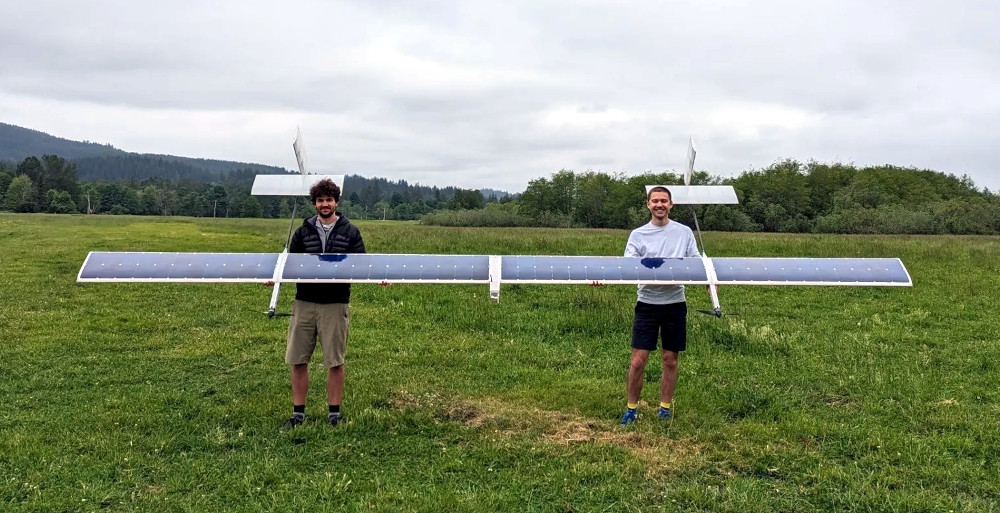 Image credit:
Radical
Image credit:
Radical
US startup Radical has developed a
high-altitude, autonomous aircraft designed to fly for months at a time
without landing – powered by nothing but sunlight. While conventional aviation
emits vast amounts of CO₂, this ultra-lightweight aircraft offers an
emissions-free alternative with powerful potential across multiple sectors –
from climate monitoring to communications.
How it works
The aircraft is powered by solar panels that charge on-board batteries –
enabling autonomous, sustained flight at high altitudes. Unlike satellites,
these aircraft can hover over precise areas for extended periods – providing
real-time, high-resolution data and coverage. Potential applications include
monitoring wildfires, weather systems and illegal activity at sea; as well as
acting as a low-orbit platform for mobile and internet connectivity, delivering
broadband directly to devices.
Radical’s innovation is not just theoretical. After testing a small prototype in
October 2023, the company has raised $4.5
million
in seed funding from investors including Scout Ventures and Y
Combinator. The next step: a full-scale test flight within the year to
validate long-duration performance.
Why climate-conscious brands should care
This isn’t about transporting passengers; it’s about enabling smarter,
climate-positive infrastructure. For companies involved in agriculture,
conservation, telecoms or ESG reporting, these aircraft could offer persistent,
zero-emissions solutions for data gathering and connectivity, at lower cost and
higher resolution than traditional satellite systems. It’s a compelling example
of how aviation innovation can extend far beyond air travel and directly serve
planet-positive business goals.
Get the latest insights, trends, and innovations to help position yourself at the forefront of sustainable business leadership—delivered straight to your inbox.
Tom is founder of storytelling strategy firm Narrative Matters — which helps organizations develop content that truly engages audiences around issues of global social, environmental and economic importance. He also provides strategic editorial insight and support to help organisations – from large corporates, to NGOs – build content strategies that focus on editorial that is accessible, shareable, intelligent and conversation-driving.
Published Jul 28, 2025 8am EDT / 5am PDT / 1pm BST / 2pm CEST